
China Lithium Ion Battery Wholesale
If you are evaluating the Lithium Ion Battery product line of Vcell Power, the following information is worthy of your attention. Founded in 2001, Vcell Power has been committed to battery R&D. It started the development of the battery technology in 2003 and launched the first 18650 cell in 2004. Currently, its product portfolio includes cylindrical cells, polymer batteries and lithium iron phosphate series, supporting customization for voltage platforms ranging from 7.4V to 72V. All products have obtained international certifications including UL, CE and UN38.3, serving customers across more than 80 countries and regions worldwide. Whether you need standard cells or customized modules, Vcell Power delivers one-stop services from solution matching to structural optimization.
Why do industry engineers pay close attention to Vcell Power’s technical background?
When assessing a battery supplier, technical development history is more valuable than marketing content. Vcell Power boasts solid and verifiable technical accumulation in the Lithium Ion Battery sector.
· Genuine technical foundation: The company initially produced Ni-MH batteries after its establishment in 2001. Foreseeing the trends of consumer electronics, it took the initiative to transform into lithium battery R&D in 2003 and realized mass production of the first 18650 cell in 2004. This timeline fully reflects its practical engineering capabilities.
· Diversified product range: Unlike manufacturers focusing on a single product type, Vcell Power operates three complete production lines for cylindrical cells (18650, 21700, 26650), polymer batteries and lithium iron phosphate batteries. It enables you to select suitable products for various application scenarios of the battery from one single supplier.
· Complete compliance certifications: Officially displayed certifications including IEC, UN38.3, UL, CE, ROHS, KC and CB are essential qualifications for products to enter European and American markets.
Choosing a supplier with complete production lines, authentic certifications and clear development history can effectively reduce compliance and delivery risks in later project stages.
How to select the right Vcell Power battery according to equipment load?
Improper model selection often causes problems after products are launched. Below is the standard selection process for Lithium Ion Battery, applicable to most industrial and consumer electronic devices.
Step 1: Confirm voltage platform and total energy
· The rated voltage of equipment motors or control boards determines the series connection of battery packs. Common voltage platforms include 7.4V, 11.1V, 14.8V, 24V, 36V, 48V, 60V and 72V.
· Total energy (Wh) = Voltage (V) × Capacity (Ah). It is recommended that the total energy of the battery pack be no less than 1.5 times the daily power consumption of the equipment to reserve a safe margin.
Step 2: Evaluate discharge rate requirements
· Low power (<0.5C): Sensors, RTC clocks and low-power meters. Standard capacity cells are applicable.
· Medium to high power (0.5C-2C): Portable medical devices, power tools and drones. High-rate cells are required.
· High power (>2C): High-power starting equipment. Multi-parallel structure or dedicated power cells are needed.
Step 3: Define physical dimensions and thermal management
· Accurately measure the length, width and height of the battery compartment. Cylindrical cells such as 18650 fit regular spaces, while soft-pack polymer batteries adapt to irregular structures.
· For high-rate discharge scenarios, reserve heat dissipation gaps for the Lithium Ion Battery to avoid performance degradation and shortened cycle life caused by heat accumulation.
Core Parameter Comparison
Upgrading equipment from lead-acid or Ni-MH batteries brings obvious advantages in energy density, cycle life and weight. The table below shows a detailed comparison and applicable scenarios of different battery chemistries.
|
Battery Type |
Typical Energy Density |
Reference Cycle Life |
Weight Feature |
Recommended Application Scenarios |
|
Vcell Power Lithium Ion |
150-200 Wh/kg |
Over 700 cycles |
Light |
Consumer electronics, power tools, portable devices |
|
Vcell Power Lithium Iron Phosphate |
90-120 Wh/kg |
Over 2500 cycles |
Moderate |
Household energy storage, solar power systems, backup power supplies |
|
Traditional Lead-Acid |
30-40 Wh/kg |
200-300 cycles |
Heavy |
Vehicle starting, low-end UPS |
Note: The actual cycle life varies according to cell chemistry, depth of discharge and operating environment. The above data are typical reference ranges.
In practical projects, 36V 6000mAh 10S3P 18650 Lithium Ion Battery is widely used for electric scooters and light-duty AGVs. Meanwhile, 48V 21Ah 18650 Lithium Ion Battery features a standard voltage platform and is fully compatible with most household inverters. Each model has its own strengths, so please make comprehensive selection based on actual working conditions.
Application Fields
Vcell Power batteries are widely applied in energy storage, electric equipment, industrial devices and consumer electronics. Here are major mature application scenarios:
· Household & commercial energy storage: Cooperate with photovoltaic systems to store electricity in daytime and release power at night. Lithium iron phosphate solutions are preferred here thanks to excellent thermal stability and safety performance.
· Light electric mobility: Electric bicycles, electric scooters and golf carts. The 36V 6000mAh 10S3P 18650 Lithium Ion Battery is a mainstream solution in this field, and its lightweight design effectively extends driving range.
· Medical & industrial equipment: Portable monitors, wireless infusion pumps and commercial floor scrubbers. These devices set high requirements on the reliability and low self-discharge rate of the Lithium Ion Battery.
· Custom projects: Outdoor monitoring devices, underwater robots and more. Vcell Power supports customization for voltage platforms from 7.4V to 72V, along with integrated services for connectors and enclosures.
Lithium Iron Phosphate vs Ternary Lithium: How to Choose the Right Lithium Ion Battery Chemistry
Different chemical systems under the same Lithium Ion Battery category deliver distinct performance. Here are practical selection suggestions based on engineering experience.
Choose Ternary Lithium (NMC/LCO) if:
· High energy density is required and the equipment is weight-sensitive
· Operating current remains stable without continuous high-rate discharge
· Typical applications: Laptops, high-end vacuum cleaners, partial power tools
Choose Lithium Iron Phosphate (LFP) if:
· Long cycle life is the top priority (over 2000 cycles)
· High safety standard is required for energy storage or long-term unattended equipment
· Energy density is not a key factor and slightly heavier battery packs are acceptable
· Typical applications: Household energy storage, base station backup power, solar power systems
Vcell Power runs production lines for both chemistries of the battery. Buyers can complete product selection within one supplier, which helps streamline supply chain management.
FAQ
Q: Can Vcell Power batteries be used for household solar energy storage?
A: Yes. With properly matched BMS protection system and suitable operating environment, the batteries can meet the demands of household energy storage. Lithium iron phosphate chemistry is recommended for its superior cycle life and thermal stability for long-term energy storage use.
Q: What is the general service life of a lithium battery?
A: The actual service life depends on cell chemistry, depth of discharge and working environment. For typical 18650 lithium ion cells, when charged and discharged at 0.5C under room temperature, the capacity can maintain 70%-80% of the initial level after 500 full cycles. Lithium iron phosphate cells feature much longer cycle life.
Q: Can Vcell Power batteries directly replace the original lead-acid batteries on equipment?
A: In most cases yes. Two points need to be checked first: matching rated voltage, and replacing the original charger with a dedicated lithium battery charger, as the charging curves of the two battery types are completely different.
Q: What safety documents are required for international transportation?
A: All cells and battery packs have passed UN38.3 tests. We provide complete MSDS and transportation appraisal documents to support compliant air and sea shipping.
- View as
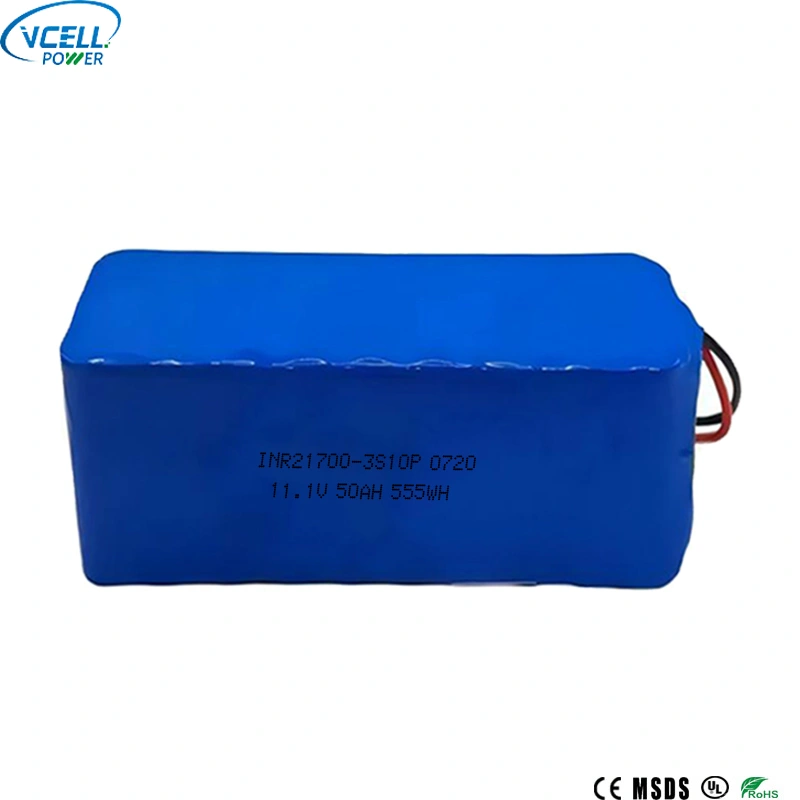
11.1V 50Ah 21700 3S10P Li Ion Rechargeable Battery
This 11.1V 50ah 21700 3s10p li ion rechargeable battery is engineered by VCELL POWER, a premier Chinese manufacturer specializing in lithium battery solutions. Leveraging over two decades of industry expertise, we enforce stringent manufacturing protocols and rigorous quality control to ensure exceptional reliability and consistency. We welcome global partnerships and look forward to exploring collaboration opportunities with you.
Read MoreSend Inquiry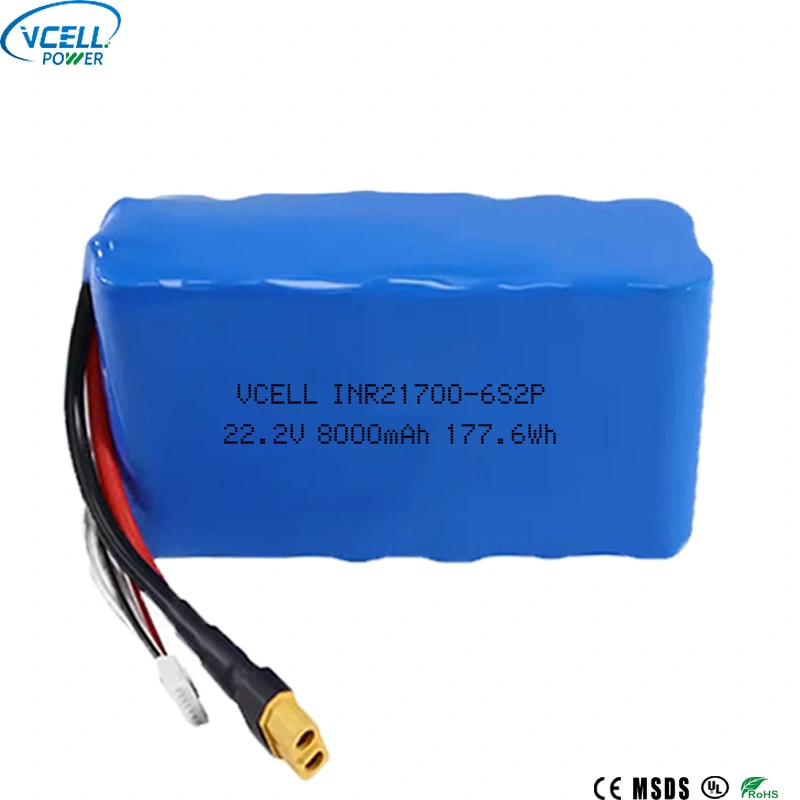
22.2V 8000mAh 21700 Lithium Ion Battery
This 22.2V 8000mAh 21700 lithium ion battery is manufactured by VCELL POWER, a professional lithium battery maker from China. Backed by 20 years of industry experience, we implement strict production workflows and rigorous QC standards to guarantee consistent battery reliability.
We welcome all cooperation proposals and are open to detailed discussions.
Read MoreSend Inquiry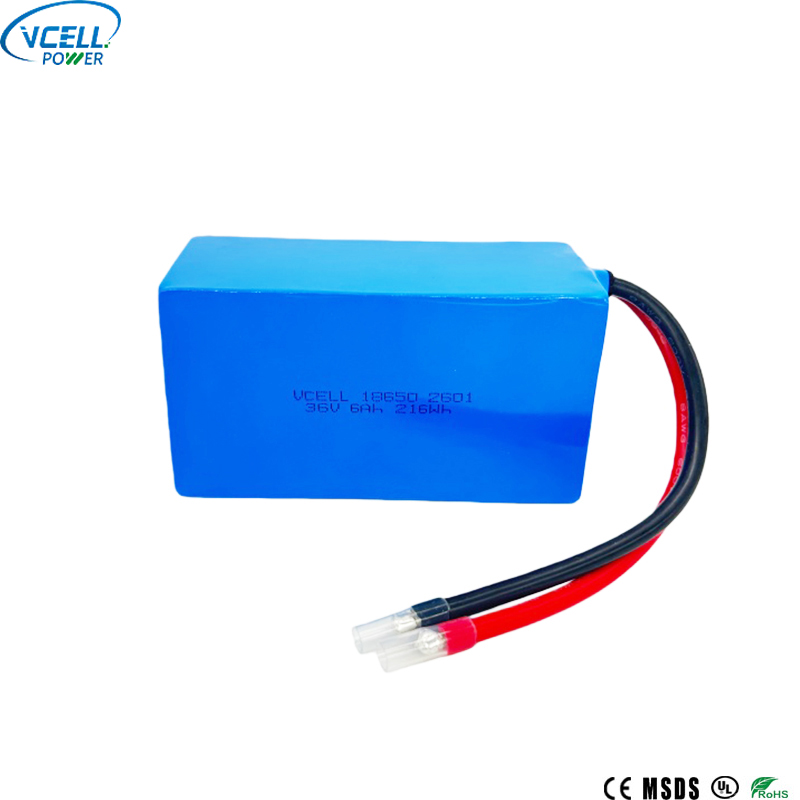
36V 6000mAh 10S3P 18650 Lithium Ion Battery
The 36V 6000mAh 10S3P 18650 Lithium Ion Battery from Vcell Power, a professional lithium battery manufacturer in China, features a 10S3P architecture with 18650 cells and a built-in BMS providing overcharge, over-discharge, overcurrent, and short circuit protection. Delivering 700+ cycles (100% DOD, 1C charge/discharge) and weighing only 1.16kg, it is an ideal power solution for e-scooters, service robots, and lawn mowers.
Read MoreSend Inquiry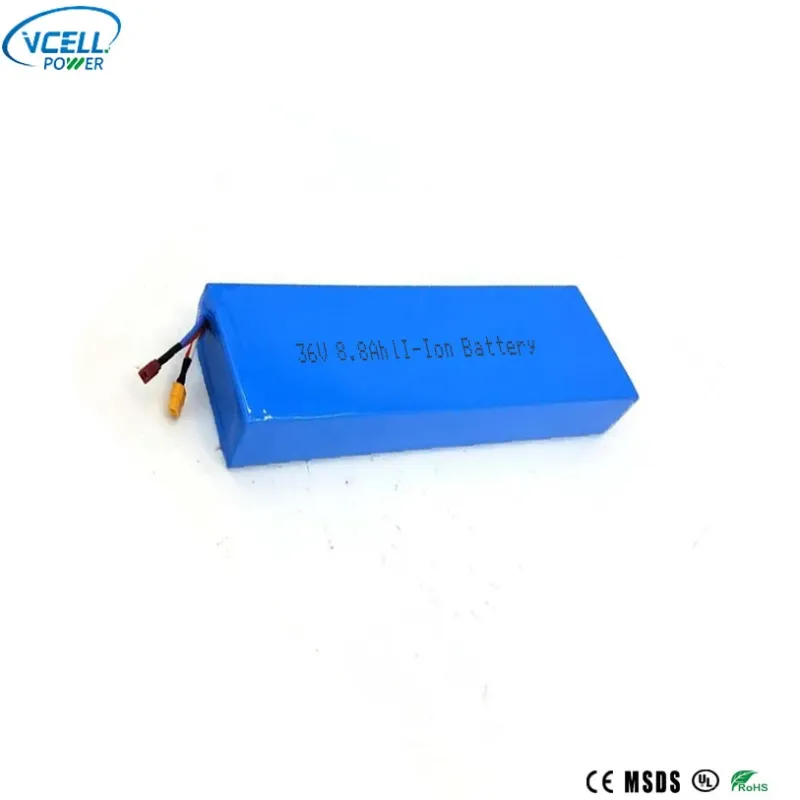
36V 8800mAh 18650 Lithium Ion Rechargeable Battery
As a professional manufacturer , Vcell Power presents 36V 8800mAh 18650 Lithium Ion Rechargeable Battery. Assembled with mature 10S4P structure, the battery achieves over 700 cycles and is equipped with BMS for multi-layer protection. It weighs approximately 2.25Kg. It balances running performance and safety, complies with international safety and transportation standards and supports OEM/ODM customization.Welcome to contact us for bulk cooperation and customized solutions.
Read MoreSend Inquiry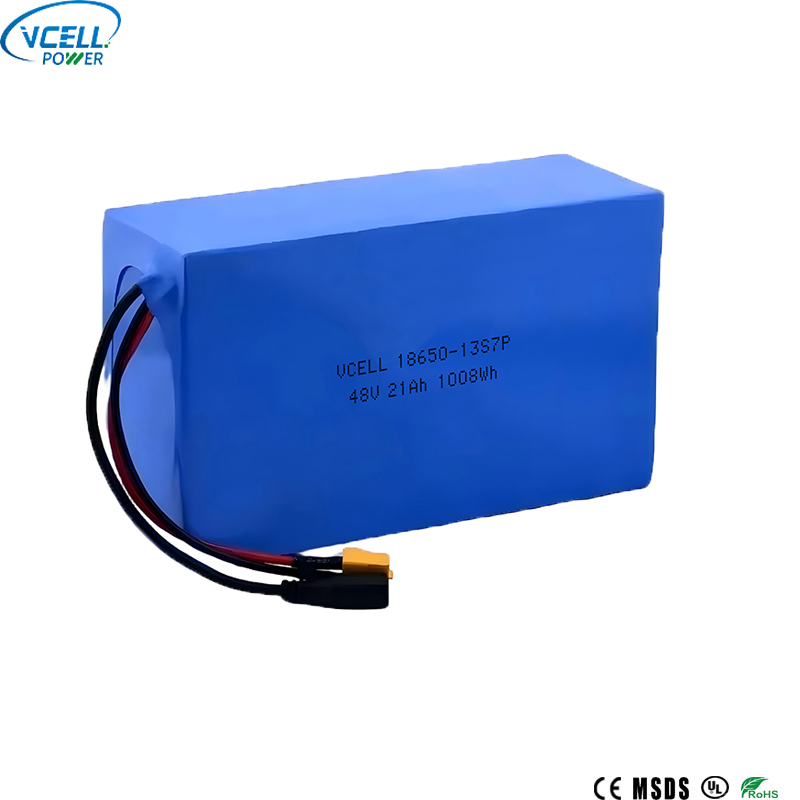
48V 21Ah 18650 Rechargeable Lithium Ion Battery
This high quality 48v 21ah 18650 rechargeable lithium ion battery from VCELL POWER, a professional battery manufacturer in China. Assembled with 13S7P high-consistency 18650 cells, it features a nominal voltage of 48V and a nominal capacity of 21Ah, capable of replacing most lead-acid batteries for 48V systems. Built-in BMS provides five-level protection against overcharge, overdischarge, overcurrent, short circuit and over temperature. With a cycle life of over 700 times, it is an ideal solution for electric two-wheelers, AGVs, outdoor energy storage and other application scenarios.
Read MoreSend Inquiry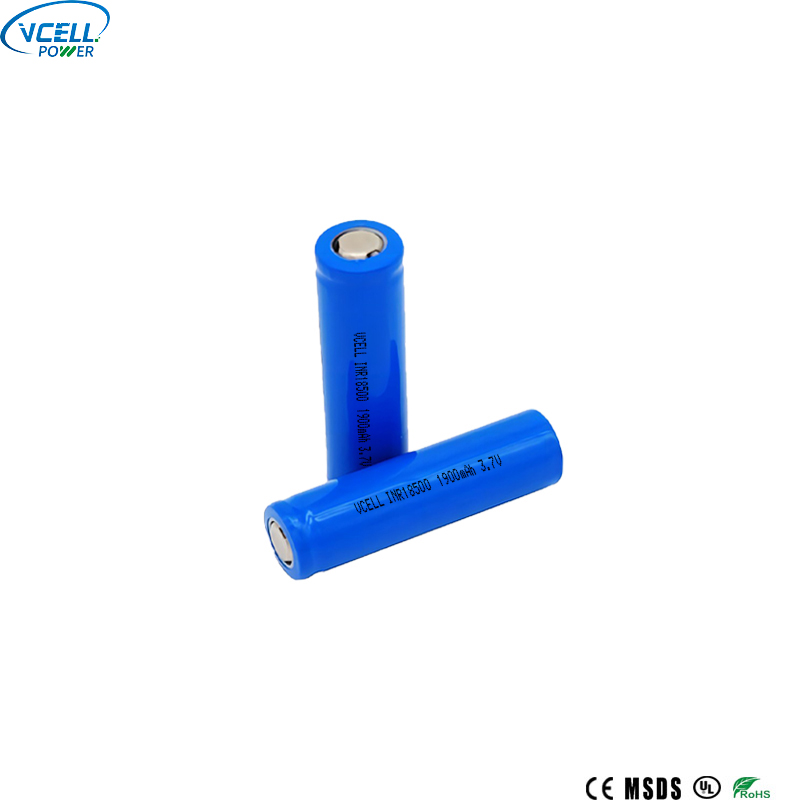
3.7V 1900mAh INR18500 Lithium Ion Battery
As a professional lithium battery manufacturer in China, Vcell Power launches the
3.7V 1900mAh INR18500 Lithium Ion Battery. Adopting lithium nickel cobalt manganese oxide material system, it features high energy density and stable voltage output. Equipped with explosion-proof valve and diaphragm explosion-proof design on the top, the battery can release internal pressure under abnormal conditions. It delivers over 700 charge-discharge cycles under standard conditions and weighs only 36g, ideal for smart locks, security cameras, outdoor lights and other devices.
Read MoreSend Inquiry
VCELL POWER is a dedicated Lithium Ion Battery manufacturer and supplier in China. We warmly welcome you to wholesale high quality products at competitive price from our factory.